Best player count
Supports 1-5 players
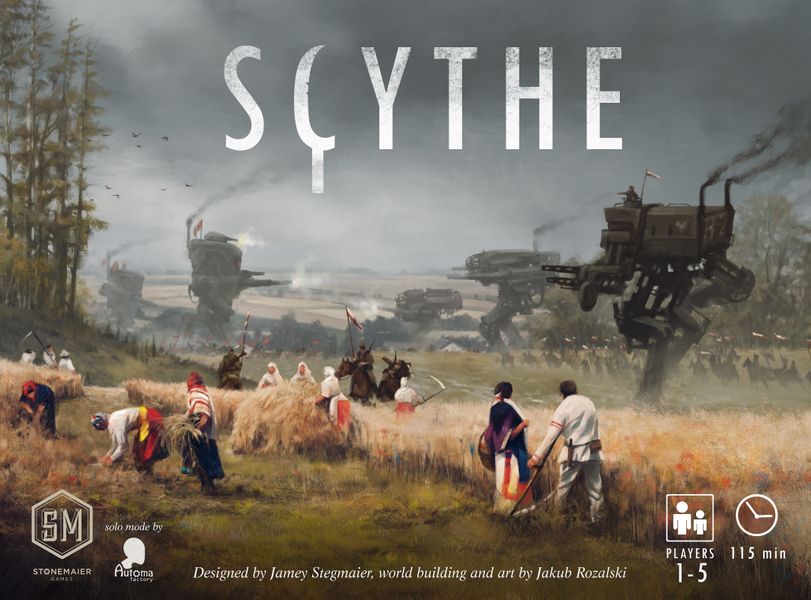
Scythe is a strategic engine-building game set in an alternate-history 1920s Europa, where you command a faction of mechs and farmers to conquer territory and claim power. Perfect for players who love deep, asymmetric strategy with no dice-based luck.
Supports 1-5 players
Typical range 115 min
BoardGameGeek complexity from light to heavy
Manufacturer recommended minimum age
It’s an alternate-history 1920s Europa, where the ashes of the first great war still darken the snow. The mysterious Factory—a capitalistic city-state that once fueled the war with heavily armored mechs—has shut its doors, and now several nearby countries eye its secrets. In Scythe, you control one of five unique factions, each starting with different resources, a distinct location, and a hidden goal. This is a game of farming and war, broken hearts and rusted gears, innovation and valor.
Your goal is to earn fortune and stake your claim around the Factory. You’ll conquer territory, enlist new recruits, reap resources, gain villagers, build structures, and activate monstrous mechs. The game uses a streamlined action-selection mechanism—no rounds or phases—keeping the pace brisk and downtime minimal. There’s plenty of direct conflict for those who seek it, but no player elimination, so everyone stays in the game until the end.
Scythe gives you almost complete control over your fate. The only elements of luck come from encounter cards you draw when exploring new lands, but each card offers multiple choices, letting you mitigate randomness. Combat is driven entirely by choices, not dice or luck. Every part of the game has an engine-building aspect: you can upgrade actions for efficiency, build structures to improve your map position, enlist recruits to enhance abilities, activate mechs to deter invaders, and expand your borders to reap greater resources. These engine-building elements create a powerful sense of momentum and progress, and the order in which you improve your engine makes each game feel unique—even if you play the same faction multiple times.